Sleep Trackers Part 1: Optimisation Culture and Sleepmaxxing
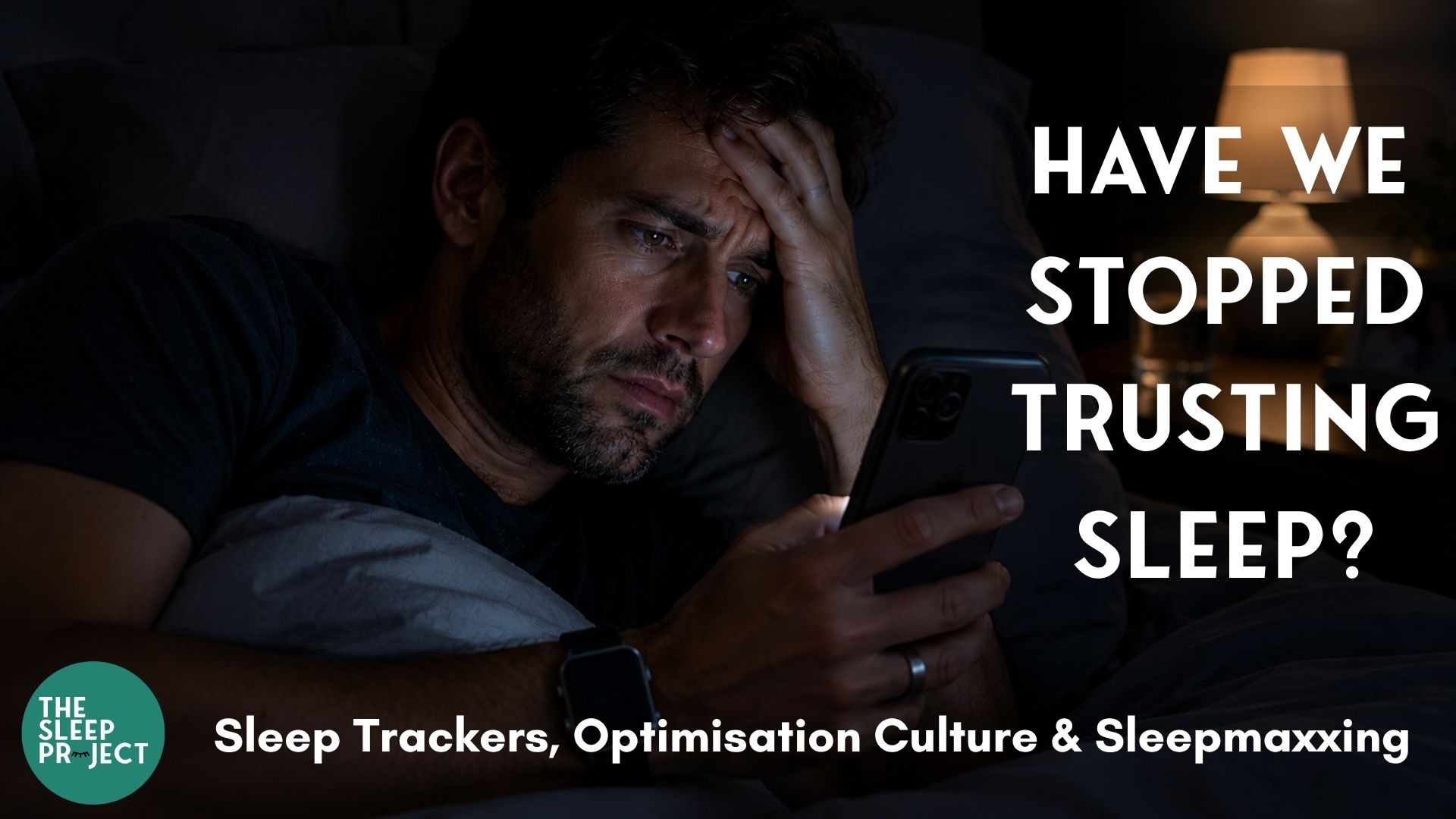
Every morning, millions of people wake up and ask a device how they slept before they ask themselves.
A watch. A ring. An app. A readiness score. A recovery score. A sleep score out of 100.
And within seconds, the tone of the day can be set.
A good score can feel reassuring. A bad score can feel like a warning. You may have woken up feeling fine, but then your tracker tells you your deep sleep was poor, your REM sleep was low, your HRV has dropped and your recovery is not optimal.
Suddenly, you feel less fine.
This is the strange place we have reached with sleep.
We are tracking it, scoring it, analysing it, optimising it and talking about it more than ever before. Sleep has moved from something we do into something we manage. Something we monitor. Something we try to perfect.
And yet many people do not seem more confident about sleep.
In fact, many seem less so.
That does not necessarily mean sleep trackers are bad. Far from it. Wearable technology can be useful. For some people, it increases awareness, encourages healthier routines and helps them spot patterns that may otherwise be missed.
But there is a big difference between using sleep data as helpful information and using it as a verdict on your body.
That difference matters.
Sleep has become another thing to optimise
We live in an optimisation culture.
We optimise our nutrition, our workouts, our productivity, our hormones, our morning routines, our nervous systems and now, increasingly, our sleep.
Some of this is genuinely helpful. Sleep matters enormously. It affects mood, memory, immune function, metabolic health, emotional regulation, pain, appetite, performance and mental health. It makes sense that people want to understand it.
But somewhere along the way, healthy curiosity can become pressure.
Sleep starts to feel like another task to complete correctly and optimally.
You need the right supplement.
The right mattress.
The right type of magnesium.
The right room temperature.
The right light exposure.
The right bedtime routine.
The right mouth tape.
The right wearable.
The right HRV.
The right score.
At some point, the message becomes: “My body can only sleep if I do everything perfectly.”
That is a heavy burden to place on a biological process.
Your body knows how to sleep. It has been doing it your whole life. Sleep is not always perfect, because life is not always perfect, but that does not mean your body is broken.
One bad night is not a disaster.
A lighter night is not failure.
Waking in the night is not automatically abnormal.
Feeling tired sometimes, or even often, does not mean you are doing life wrong.
The danger of sleepmaxxing is not that people care about sleep. Caring about sleep is a good thing.
The danger is when sleep becomes something people feel they must constantly monitor, control and fix.
What sleep trackers can actually tell us
Consumer sleep trackers do not measure sleep directly.
The gold standard test for measuring sleep is polysomnography, usually called PSG. This is the overnight sleep-lab test that records brain activity, eye movements, muscle tone, airflow, breathing effort, oxygen levels and heart rhythm.
In other words, PSG measures sleep much closer to its source.
Your smartwatch or sleep ring does not do that.
Consumer devices estimate sleep using indirect signals, usually a combination of movement, heart rate, pulse rate variability, oxygen levels and sometimes skin temperature. They do not record your brain waves. They infer sleep from what the body is doing on the surface.
That does not make them useless. It just means the numbers need to be understood for what they are: estimates.
In general, modern sleep trackers are reasonably good at detecting when you are probably asleep and estimating broad sleep timing over time. They can help you spot patterns across days or weeks, such as whether your sleep duration is gradually improving, whether your bedtime has become more irregular, or whether alcohol, travel, illness or stress is affecting your sleep.
Where they struggle more is detecting quiet wakefulness.
This is especially important for people with insomnia. If you are lying still in bed, awake but barely moving, your watch may read that as sleep. This is one reason trackers can underestimate time awake during the night or misread fragmented sleep.
And this is exactly where many people most want certainty.
When you have had a bad night, you want the number to explain it. You want to know what happened. You want reassurance that you are okay, or a clear answer about what to fix.
But disrupted sleep is precisely where consumer devices can become less reliable.
The problem with deep sleep panic
The part of sleep tracking people often worry about most is the sleep-stage breakdown.
Light sleep.
Deep sleep.
REM sleep.
These numbers look very precise. They can feel medical. But they are the least reliable parts of consumer sleep tracking.
Different devices can give different results for the same night. Some devices may overestimate light sleep. Others may underestimate deep sleep. Sleep-stage estimates can be wildly inaccurate on any given night.
That matters because people often take these numbers very literally.
If your ring tells you that you only had 28 minutes of deep sleep, it is easy to assume something has gone wrong. But that number is not a diagnosis. It does not mean your brain failed. It does not mean your body has forgotten how to recover. It does not mean you need to panic-buy five supplements before breakfast.
Sleep stages are not fixed targets you have to hit every night.
They vary naturally. They are influenced by age, illness, stress, alcohol, medication, sleep timing, previous sleep, hormonal changes and many other factors. They also vary across the night and across different nights.
One poor-looking sleep-stage graph is not proof of poor sleep.
This is one of the most important messages for anyone using a sleep tracker: pay more attention to patterns than single nights, and be especially careful with deep sleep and REM sleep numbers.
HRV is useful, but it is not a verdict
Heart rate variability, or HRV, has become another major part of sleep and recovery culture.
In simple terms, HRV reflects variation in the time between heartbeats. A healthy heart does not beat like a metronome. It varies from beat to beat, partly because of the way the autonomic nervous system regulates the heart.
That physiology is real.
But the interpretation is often oversimplified.
Most wrist-based devices are not measuring ECG-derived HRV in the way a clinical test would. They usually use optical sensors on the skin to detect pulse waves. This is related to HRV, but it is not exactly the same thing.
Movement, sensor noise, rhythm changes, skin tone, body position and device algorithms can all affect the number.
So yes, HRV can be useful as a trend. If your HRV is consistently lower than usual, it may reflect illness, stress, alcohol, overtraining, poor recovery or general strain.
But a single low HRV reading should not become a story about your body being broken.
It is not a diagnosis.
It is not a moral failure.
It is not proof that you are unwell, unfit or doing life wrong.
A low HRV morning may be useful context. But it should not become the first thing that frightens you before the day has even begun.
The good side of sleep tracking
It is important to be fair here.
Sleep trackers can be genuinely helpful.
They can help people notice that they are sleeping less than they thought. They can show how inconsistent bedtime and wake-up time have become. They can reveal the effect of alcohol, late caffeine, jet lag, shift work, stress or illness. They can help people connect their daily choices with their sleep patterns.
For some people, tracking sleep can create motivation and accountability. It can open up useful conversations with clinicians. It can help people understand that sleep is not just about bedtime, but about light, rhythm, recovery, routine and the whole 24-hour day.
Wearables may also help flag possible medical issues. Some devices now include features that can prompt users to seek assessment for possible irregular heart rhythms or sleep apnoea risk. These alerts should never be treated as a diagnosis, but they may be a useful reason to speak to a doctor.
The best use of sleep tracking is not perfection.
It is pattern recognition.
The question is not, “Did I get a perfect score last night?”
The better question is, “What is happening over time?”
When tracking becomes over-tracking
The problem starts when sleep tracking stops being information and becomes surveillance.
For some people, the sleep score becomes the first stressful event of the day.
They wake up and feel okay, then check the app and feel anxious. They start cancelling exercise, avoiding plans, changing meals, adding supplements or worrying about the next night based on one poor score.
Then bedtime becomes a performance.
The bedroom becomes a testing centre.
And sleep becomes something to achieve.
This is where tracking can become part of the problem. Clinicians have described “orthosomnia”, where the pursuit of perfect sleep data increases anxiety and worsens the sleep it was meant to improve.
That does not happen to everyone. Some people can track sleep casually and use the data sensibly. Others become more preoccupied, especially if they already struggle with insomnia, anxiety, perfectionism or health worries.
A useful question to ask yourself is:
How do you feel after checking your sleep data?
Curious?
Reassured?
Informed?
Or anxious, disappointed, frustrated and more determined to control the next night?
If the data is making you more scared of sleep, it may be time to step back.
Information is not always the same as reassurance
One of the most interesting things about the rise of AI, sleep trackers and sleepmaxxing is that many people are not really looking for more information.
They are looking for reassurance.
When you are lying awake at 2am, exhausted and fed up, certainty feels incredibly attractive.
You want to know what is wrong.
You want an answer.
You want someone, or something, to tell you how to fix it.
The challenge is that sleep difficulties are rarely caused by a lack of information alone.
Most of the people we work with already know a lot about sleep.
They’ve read about magnesium.
They know about circadian rhythms.
They’re aware of the impact of caffeine and stress.
Now they can ask AI too.
But the issue is often not knowledge.
The issue is confidence.
Somewhere along the way, sleep stopped feeling like something the body knows how to do and started feeling like something that needs managing, optimising, monitoring and fixing.
What often needs rebuilding is not sleep itself.
It is trust.
Trust that one bad night is not a disaster.
Trust that normal fluctuations are just that: normal.
Trust that your body has not forgotten how to sleep.
AI can provide information.
A sleep tracker can provide data.
But neither can rebuild your relationship with sleep.
That is the work.
How to use your sleep tracker without losing your mind
If you use a sleep tracker and find it helpful, you do not need to throw it away.
But it may help to change your relationship with it.
Look at trends, not single nights.
Pay more attention to sleep timing, regularity and approximate duration than to exact deep sleep or REM sleep minutes.
Do not compare your sleep score with someone else’s.
Do not change your whole routine because of one bad score.
Notice how you feel before checking the app.
Treat health alerts as prompts to seek medical advice, not as diagnoses.
Be cautious with recovery scores, readiness scores and HRV interpretations.
Remember that quiet wakefulness can be misread as sleep.
Take a break from tracking if the data is making you anxious.
And most importantly, do not let a device become the authority on how you are allowed to feel.
When to seek proper help
Sleep trackers are not diagnostic tools.
If you are regularly struggling to sleep, lying awake for long periods, waking frequently, feeling very sleepy in the day, snoring heavily, waking gasping or choking, experiencing restless legs, acting out dreams, or feeling frightened of sleep, it is worth seeking proper clinical advice.
A tracker may give useful background information, but it cannot diagnose insomnia, sleep apnoea or other sleep disorders.
It also cannot replace evidence-based treatment.
For insomnia, the recommended first-line treatment is CBT-I, which works by rebuilding the body’s sleep drive, stabilising the sleep-wake pattern, reducing unhelpful sleep effort and restoring confidence in sleep.
That is very different from simply adding more data.
The real goal
The goal is not to know less about sleep.
The goal is to become less frightened by sleep.
Data can be useful. AI can be useful. Sleep trackers can be useful. Biohacking can start from a very reasonable place: wanting to feel well, live well and recover well.
But none of these tools should become the thing that decides whether you trust your own body.
A sleep tracker can give you information.
It can show patterns.
It can sometimes point you towards a problem worth investigating.
But it cannot rebuild your relationship with sleep.
That is the deeper work.
Because sleep is not just a score.
It is not a nightly exam.
It is not a competition.
It is a biological rhythm your body has been practising your whole life.
And perhaps the next frontier in sleep health is not more tracking, more optimisation or more data.
Perhaps it is learning how to listen again.
If sleep has become something you dread, monitor or constantly try to control, Retrain Your Sleep can help you rebuild confidence and sleep more naturally using evidence-based CBT-I techniques.
Click here to learn more about Retrain Your Sleep.
Click here to read part 2 in our sleep trackers series: How Accurate Is Your Sleep Tracker?

Dr Eidn Mahmoudzadeh is a Sleep Doctor and NHS GP with over 20 years of clinical experience. He is a regular guest on podcasts, a frequent contributor to press and media discussions, and a keynote speaker at many prestigious industry and NHS events.
References
Baron KG, Abbott S, Jao N, Manalo N, Mullen R. Orthosomnia: Are Some Patients Taking the Quantified Self Too Far? Journal of Clinical Sleep Medicine. 2017;13(2):351–354. doi:10.5664/jcsm.6472.
Chinoy ED, Cuellar JA, Huwa KE, Jameson JT, Watson CH, Bessman SC, et al. Performance of Seven Consumer Sleep-Tracking Devices Compared With Polysomnography. Sleep. 2021;44(5). doi:10.1093/sleep/zsaa291.
Lee YJ, Lee JY, Cho JH, Kang YJ, Choi JH. Performance of Consumer Wrist-Worn Sleep Tracking Devices Compared to Polysomnography: A Meta-Analysis. Journal of Clinical Sleep Medicine. 2025;21(3):573–582. doi:10.5664/jcsm.11460.
Robbins R, Weaver MD, Sullivan JP, Quan SF, Gilmore K, Shaw S, et al. Accuracy of Three Commercial Wearable Devices for Sleep Tracking in Healthy Adults. Sensors. 2024;24(20):6532. doi:10.3390/s24206532.
Shaffer F, McCraty R, Zerr CL. A Healthy Heart Is Not a Metronome: An Integrative Review of the Heart’s Anatomy and Heart Rate Variability. Frontiers in Psychology. 2014;5:1040. doi:10.3389/fpsyg.2014.01040.
Spina MA, Andrillon T, Quin N, et al. Does Providing Feedback and Guidance on Sleep Perceptions Using Sleep Wearables Improve Insomnia? Findings From “Novel Insomnia Treatment Experiment”: A Randomized Controlled Trial. Sleep. 2023;46(9). doi:10.1093/sleep/zsad167.
Yuda E, Shibata M, Ogata Y, et al. Pulse Rate Variability: A New Biomarker, Not a Surrogate for Heart Rate Variability. Journal of Physiological Anthropology. 2020;39(1):21. doi:10.1186/s40101-020-00233-x.
Join our mailing list below to get exclusive early access to
free educational content, tools and other goodies!
We won't send spam. Unsubscribe any time.